
01A CLEARER CASTING PURCHASE
Cast-Iron Counterweights for Equipment
Order the balancing body and its mounting surfaces around your equipment design. Relia supplies custom cast-iron counterweight enquiries with machining and painting for loaders, forklifts, excavators and cranes. Define target mass, centre-of-gravity requirements and the installed envelope together. The part must sit correctly and transfer loads through its mounts as well as meet the specified weight.
- Design
- Mass + centre of gravity
- Fit
- Mounting + installed envelope
- Supply
- Casting, machining + paint
02A CLEARER CASTING PURCHASE
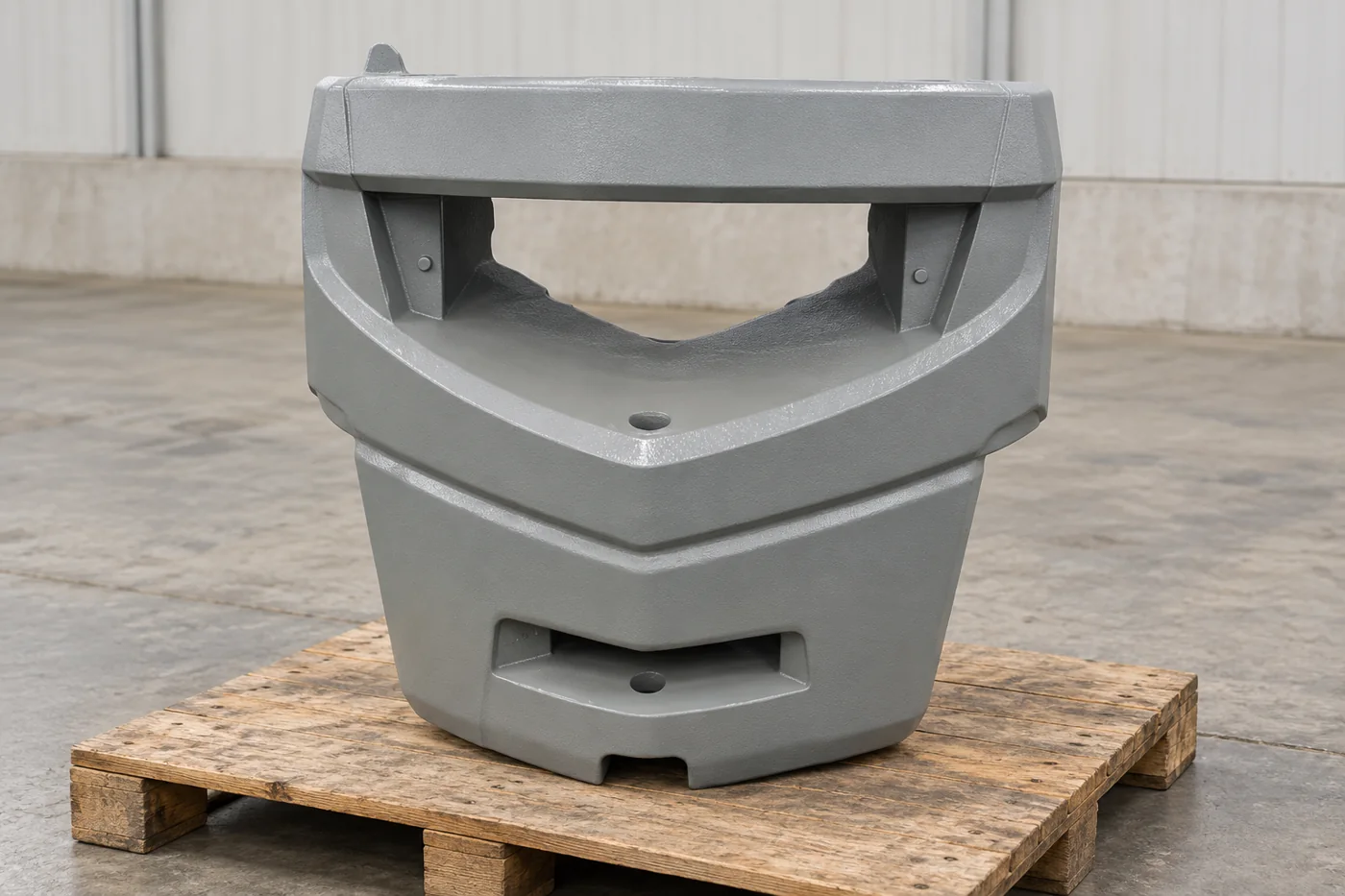
Shaped balance blocks with finished mounting surfaces
Relia offers OEM/ODM cast-iron counterweights from customer drawings, including sand/vacuum-casting requests and a related grey-iron lost-foam range. Casting, machining, painting and custom colour are available within the relevant product scope. Our main foundry route is coated-sand or shell moulding, with the actual route chosen for the counterweight geometry rather than imposed on every size and shape.
For a machinery OEM, the benefit is one component definition from cast body to mounted and painted block. The related grey-iron listing permits a one-piece enquiry, which can support initial development without turning that quantity into a rule for every counterweight. Relia’s new-part process is drawing review, sample manufacture and inspection, your confirmation, then batch production. Real equipment photographs and dimensional or material reports can support your supplier assessment.
03A CLEARER CASTING PURCHASE
Mounting features and lifting features have different duties
Mounting faces and fasteners retain the counterweight during equipment use. Handling points support it during manufacturing, transport or installation. Their loading direction and contact arrangement can differ substantially, so an opening used for location should not automatically become a lifting point.
Define the mounting contact, hole pattern, fastener access and any locating shoulders. Where the order includes engineered lifting features, give their design requirements, permitted handling arrangement and acceptance evidence. This lets us discuss machining and local casting details around the actual interfaces while your equipment team controls the complete lifting and stability design.
| Feature group | Required definition |
|---|---|
| Equipment mounting | Seating face, fixing pattern, locating shoulders and installed clearance. |
| Handling arrangement | Defined support or lifting locations and permitted contact zones. |
| Recesses | Geometry retained for clearance, assembly access and mass distribution. |
| Delivered identity | Part, orientation, revision and any matched installation reference. |
04A CLEARER CASTING PURCHASE
Recesses influence both fit and mass distribution
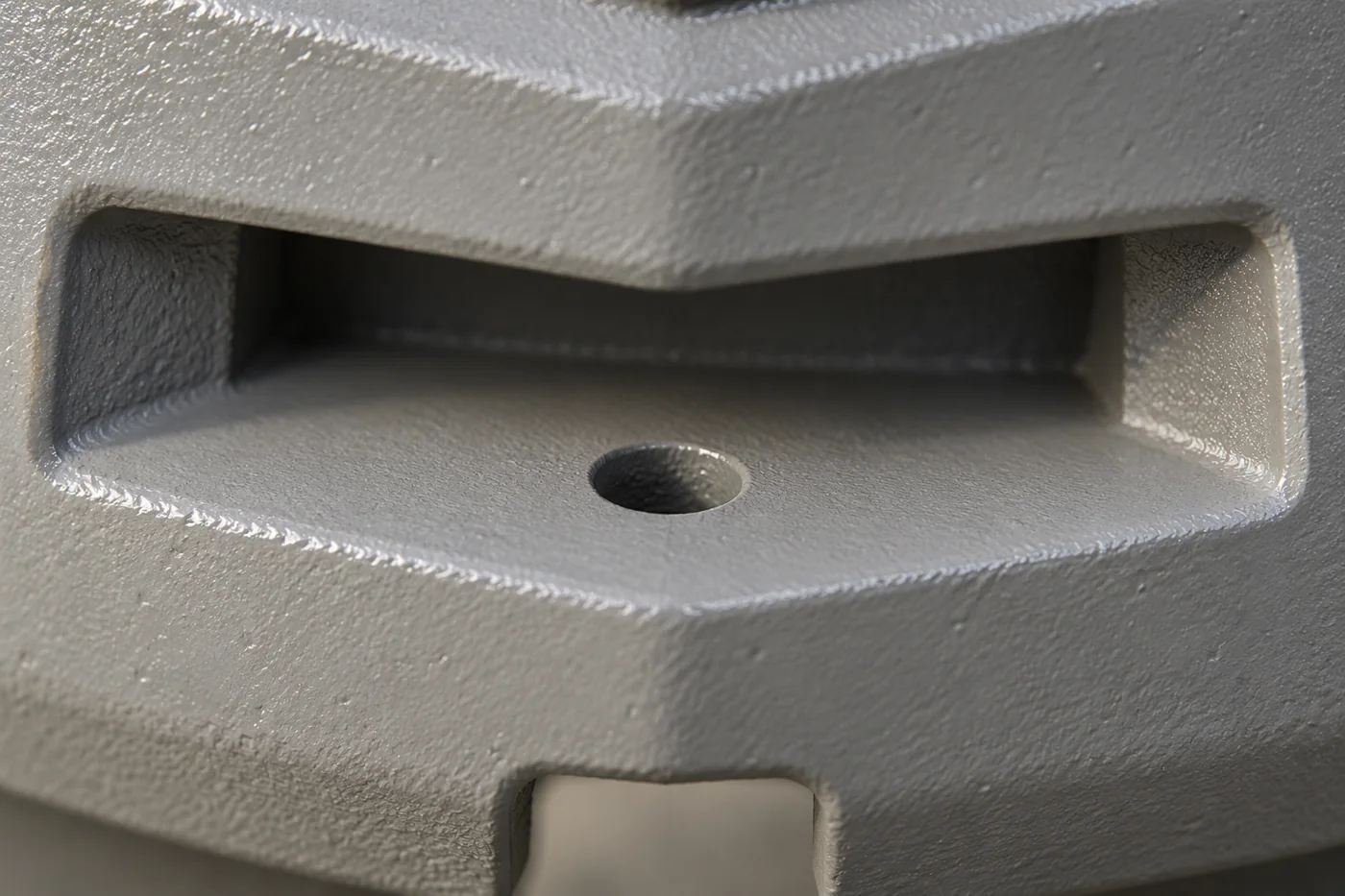
A recessed upper region can provide installation space, reduce local mass or accommodate a connected structure. Its purpose should remain visible in the drawing. Removing material from one side affects distribution differently from removing the same amount symmetrically.
Mark surfaces that cannot move and regions where the design permits adjustment. If machining is proposed to reach the final mass, identify the permitted correction zone and limits before manufacture. Uncontrolled grinding at the mounting face could change the installed position; a permitted mass-correction area keeps that adjustment away from the functional seating geometry.
- Recess purpose
- Clearance, connection or mass distribution
- Correction zone
- Keep adjustments away from mounting datums
05A CLEARER CASTING PURCHASE
The mould route retains mass and mounting geometry
A counterweight is often a shaped casting with recesses and rear-side mounting features, rather than a simple solid slab. In tooling review, the outside envelope, wall sections and permitted mass-adjustment zones belong to the same model. A parting arrangement that preserves a mounting face may need a different core or machining solution for a rear recess. The selected sand/vacuum or lost-foam route changes the tooling package, but not the required installed function.
Thick areas cool differently from narrow ribs or attachment regions. Feeding and cooling decisions need to avoid leaving a local shrinkage problem inside a block that happens to achieve its total mass. Cleaning removes the mould material and gates; machining then establishes seating contacts and fixing locations. Where final mass correction is allowed, it should use a designated zone so that removing material does not move a datum or spoil the intended balance position.
Painting follows the agreed preparation and masking plan. Weighing must use the selected delivered condition, with fittings and tare handled consistently. The useful release output combines net mass with mounting dimensions and any required centre-of-gravity verification. That gives your team evidence for the counterweight itself while the complete machine retains its own stability approval.
- 01Retain the balance modelKeep mass distribution and installation shape together through tooling.
- 02Choose the mould routeForm the actual shaped block using a suitable tooling package.
- 03Cast, clean and machineProduce a sound body with usable seating and fixing geometry.
- 04Finish and weighAccept the actual delivered counterweight rather than shipping gross mass.
- 05Release the sample definitionCarry the accepted component into repeat supply.
06A CLEARER CASTING PURCHASE
Mass acceptance uses an identified weighing condition
State whether acceptance applies to the bare casting, machined block or painted component, and whether fittings are included. A shipping gross weight includes packaging; it is not the net mass of the counterweight. The weighing record should identify the component, result, units, scale and acceptance limits, with tare treatment where supports or packaging are present.
Scale resolution and calibration suitability need to match the required mass decision. Separately inspect mounting and envelope dimensions: a correct mass result cannot establish that a block seats correctly. Where centre-of-gravity evidence is required, specify its measurement or calculation basis as another distinct characteristic.
07A CLEARER CASTING PURCHASE
The installed envelope protects service access
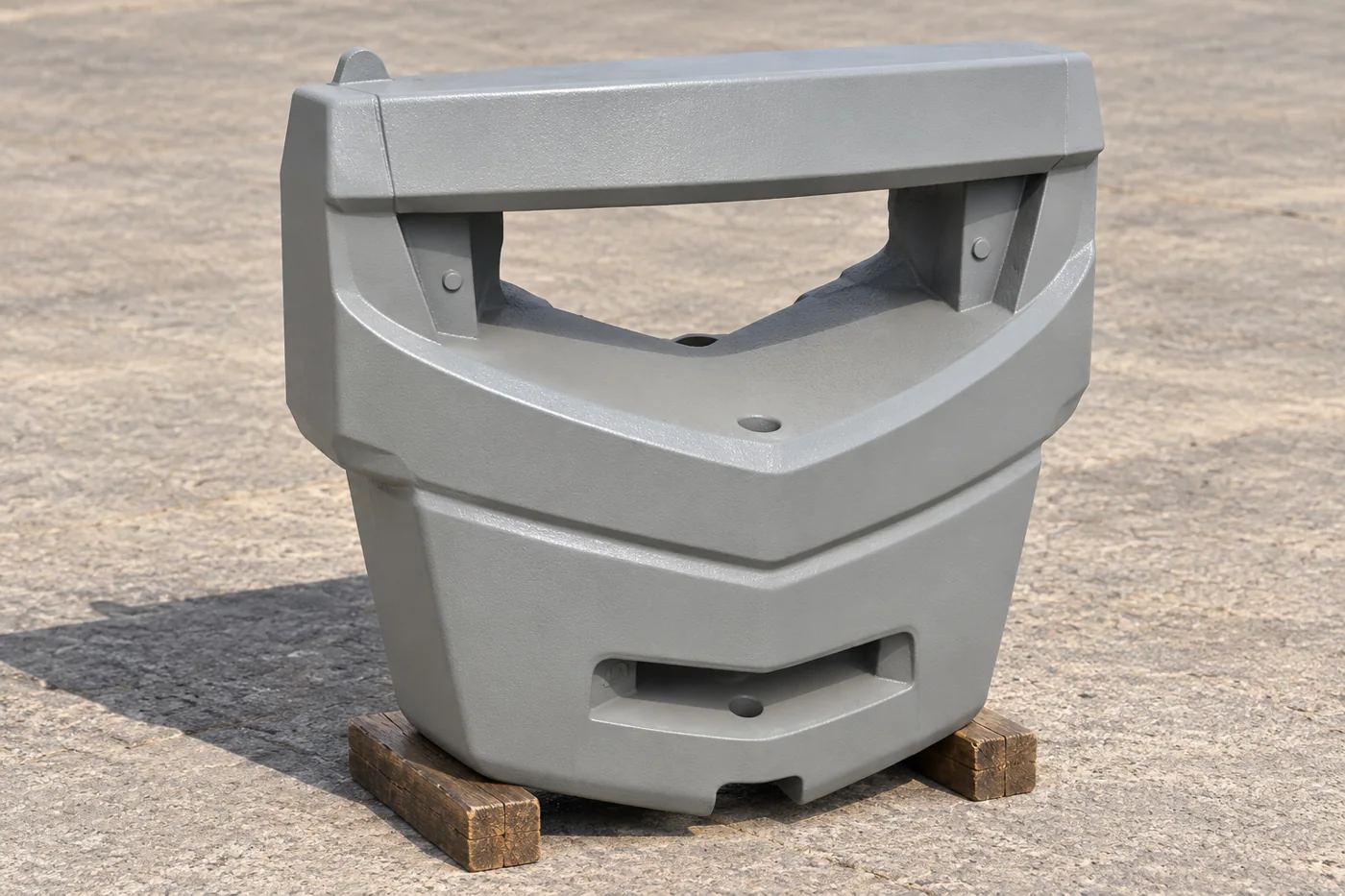
Counterweights often wrap around equipment structures rather than form simple solid blocks. Show the full outside contour, cut-outs and rear-side interfaces, including access needed to install fasteners and remove neighbouring covers. Check those restrictions in the installed orientation.
A proposal that changes a radius or local wall may still meet an overall length and width while affecting access or the position of the centre of gravity. Use section views and controlled profiles for these regions. We can then review manufacturing details around the intended envelope without changing its equipment function.
08A CLEARER CASTING PURCHASE
Finish and dimensional acceptance share one release
Casting, machining and painting are named for the balance-block listing; sandblasting is named for the related gray-iron range. Specify preparation, colour, coverage and the required final appearance. Mask locating contacts and fastening interfaces where the drawing requires bare material or a controlled coating condition.
Record the mass acceptance stage alongside these operations. The unqualified catalogue tolerance reference of 0.02 is not a complete drawing requirement; meaningful limits need a unit, characteristic and finished stage. A feature-specific inspection schedule makes the quotation comparable and avoids confusing a surface finish request with an installation tolerance.
- 0101Set machined mounting dimensions with units and datums.
- 0202Define blast preparation, paint coverage and masking.
- 0303Weigh the agreed finished component configuration.
- 0404Record mass, dimensions and final appearance against one revision.
09A CLEARER CASTING PURCHASE
Delivery supports protect the heavy component
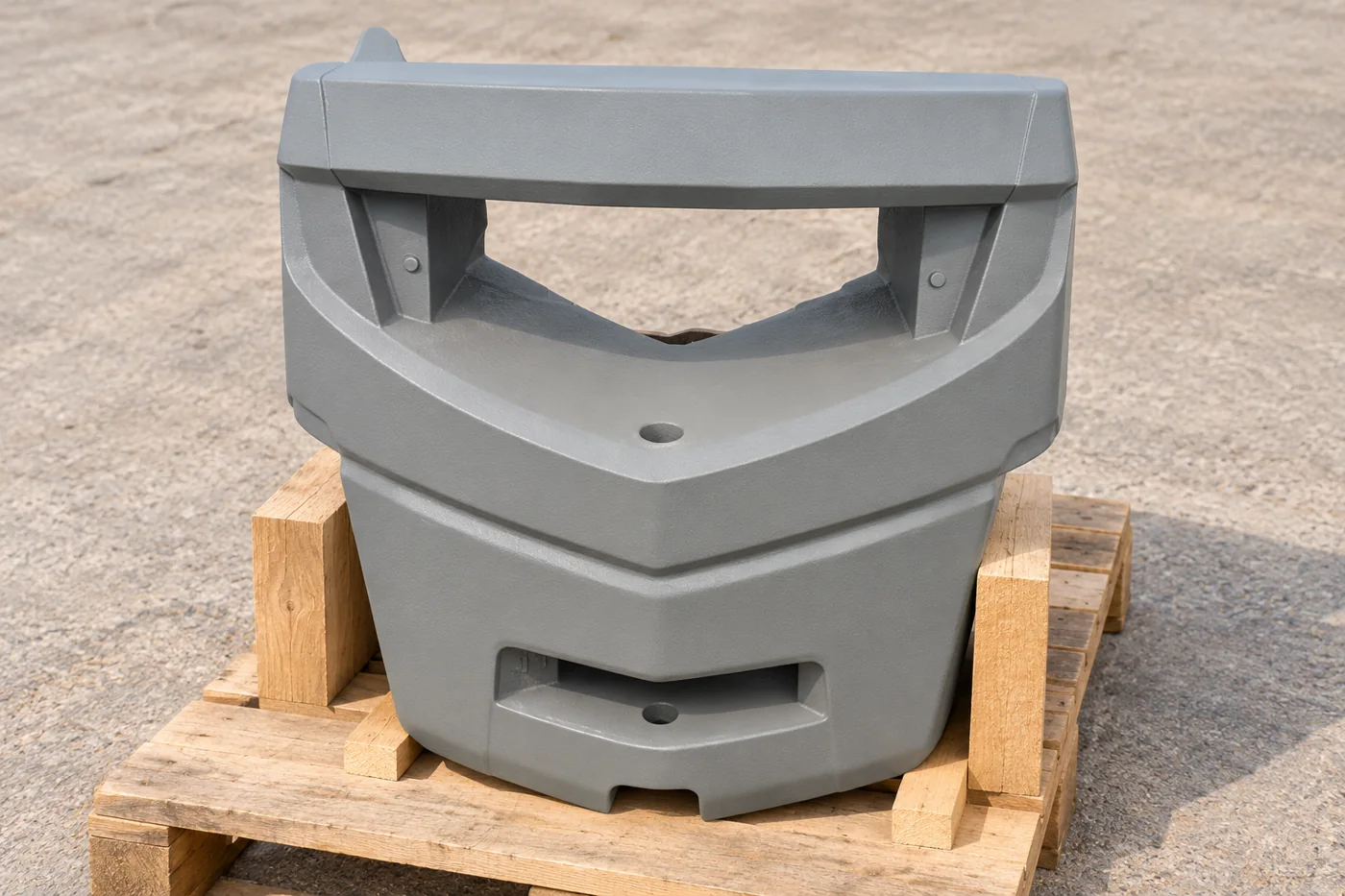
A counterweight should rest on agreed support areas that keep it stable and protect its machined contacts. Timber blocks and spacers in the illustration show the principle of separation; the actual support and restraint arrangement must suit the ordered geometry and shipping method. Carton, wooden-case and customized packing are catalogue options.
Define receiving access, package orientation and the surfaces that may carry transport contact. Keep the component identity accessible without disturbing the load. This helps your receiving team relate the block to the weighing and dimensional records while planning its approved unloading and installation method.
- Support
- Agreed stable contact areas
- Receiving record
- Part identity and weighing condition
10A CLEARER CASTING PURCHASE
The quotation retains the balance design
Send the released model with target mass and permitted variation, the selected grade and the intended installed position. Add centre-of-gravity requirements where the equipment design needs them, plus mounting dimensions and any permitted mass-adjustment zones. We can then quote the relevant casting, machining and finish package.
Agree the test-report contents before production: the catalogue provides a report, while the order determines the relevant characteristics and acceptance criteria. For a first component and subsequent batches, retain the same mass state, mounting references and packing arrangement so comparisons remain meaningful.
11 YOUR NEXT STEP
Bring your component into the conversation
Tell us which component you need, the material, quantity and required supplied condition. Relia will connect your enquiry with the casting, machining and evidence relevant to that part.
Technical reading and scope
Technical references explain the process. Component specifications and agreed order records define the actual supply.
OSHA: Powered industrial truck stabilityNIST: Scale selection and weighing suitabilitySFSA: Casting design, feeding and machining allowances- [email protected]
- Phone
- +86 18561762631
- +1 404 203 0971
- Company and address
- Qingdao Relia Industries Co., Ltd.
Shuyuan Road, Qingdao, Shandong, China